Drain Field Service in Spokane
Drain field service in Spokane: signs of a failing field, what restoration involves, and how glacial soil and the water table affect the work.
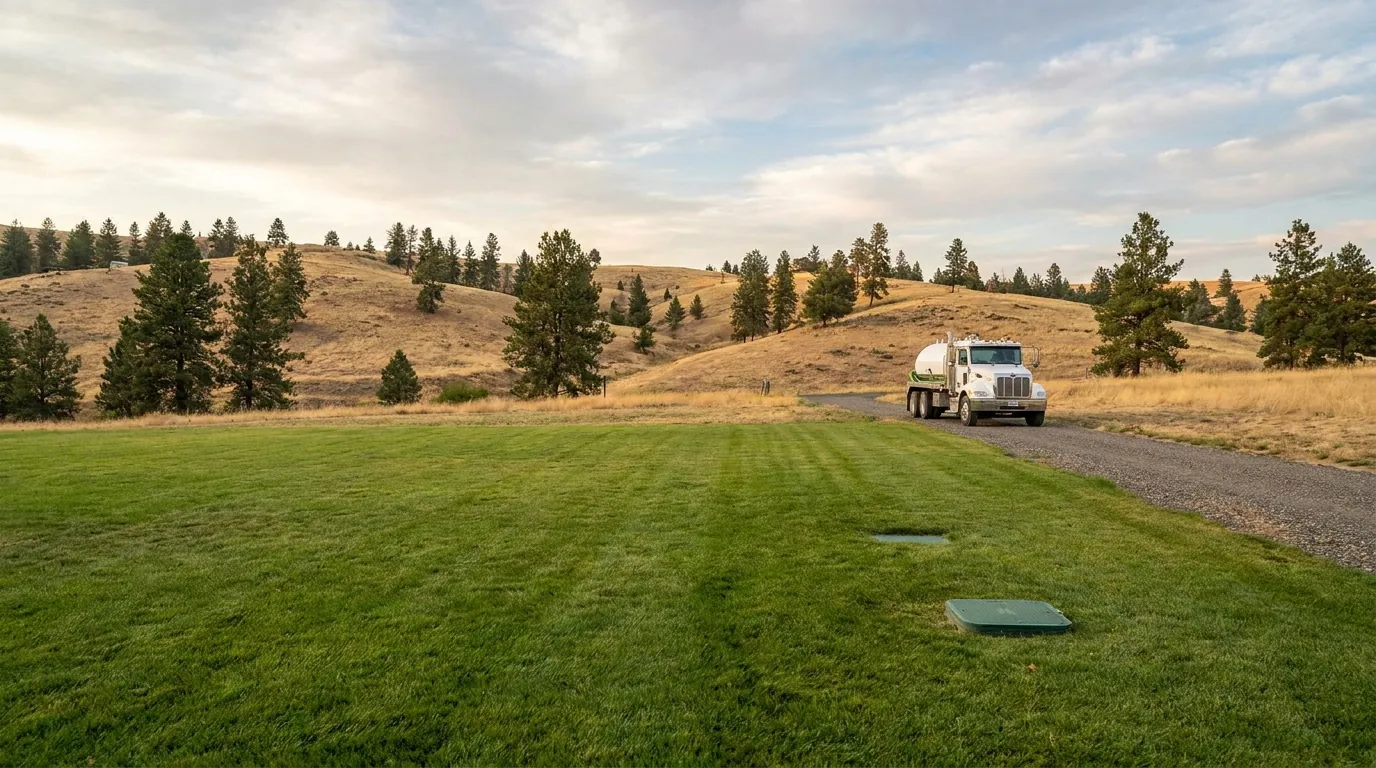
What the drain field does and how it fails
The drain field — sometimes called the leach field — is where the clarified liquid from your tank soaks into the soil and gets its final filtering. It is the most expensive part of a septic system to replace and the part most sensitive to neglect. When solids escape an overdue tank, or when the soil below the field gets overloaded or waterlogged, the field stops accepting water. Effluent then has nowhere to go, and it surfaces or backs into the house.
The warning signs are hard to miss once you know them: patches of ground over the field that stay wet or spongy in dry weather, grass that is noticeably greener or taller in strips, sewage odor outdoors, and drains that back up even though the tank was recently pumped. That last one is the tell that separates a field problem from a tank problem — if pumping does not fix slow drains, the field is the suspect.
How drain field service works
Field service starts with figuring out why the field is struggling, because the cause decides the fix.
-
Confirm the diagnosis
We rule out a full tank and clogged baffles first, since those mimic field failure and are far cheaper to correct. This usually means a look at the tank alongside the field.
-
Assess saturation and flow
We check the liquid level in the tank, the field surface, and how the system responds to water. A tank backed up to the outlet with a wet field points to a field that cannot drain.
-
Relieve overload where possible
Pumping the tank and clearing filters removes solids that may be smothering the field, and reducing water into the system gives a marginal field a chance to recover.
-
Evaluate for restoration or replacement
Some fields recover with reduced load and time; others are biologically clogged or physically failed and need rehabilitation or replacement, which involves permitting through the county.
-
Plan next steps
You get an honest read on whether your field can be nursed along or needs to be rebuilt, with the reasons laid out.
Spokane soil and water table make or break a field
A drain field lives or dies on the soil beneath it, and Spokane's glacial deposits are famously variable. Coarse, gravelly ground drains fast and forgives a lot; tighter silty soils accept water slowly and leave less margin for error. The same overloaded household that works fine on gravel can push a field in slow soil into failure. That is why two neighbors can have very different experiences with identical systems.
Water table is the other half of the story. Eastern Washington summers are dry, but wet winters and spring snowmelt raise groundwater in low areas — near the river, around Green Bluff, and in parts of Suncrest and Otis Orchards-East Farms. When the water table rises into the zone the field relies on, the field temporarily loses its ability to drain, and a marginal system chooses that moment to fail. Protecting a field starts upstream with regular septic tank pumping so solids never reach it, and a septic system inspection is the best way to catch field trouble while options are still open.
Get your drain field looked at
Wet ground over the field or backups that pumping does not cure are worth acting on early. Describe what you are seeing and we will help sort out the cause.
Early diagnosis is what keeps a field problem from becoming a replacement.
Frequently asked questions
How do I know if the problem is my tank or my drain field?
If pumping the tank clears the slow drains, it was the tank. If drains stay slow after a pump-out and the ground over the field is wet or smelly, the field is the likely cause. An inspection confirms which.
Can a failing drain field be saved?
Sometimes. Fields that are overloaded or temporarily saturated can recover when solids are removed and water use is reduced. Fields that are biologically clogged or physically failed usually need rehabilitation or replacement.
Why does my field get worse in winter?
Wet winters and spring snowmelt raise the water table around Spokane, especially in low-lying areas. When groundwater rises into the field's soil, the field temporarily cannot accept effluent, so a marginal system shows symptoms it hides in summer.
Does regular pumping protect my drain field?
Yes, it is the single best thing you can do for it. Pumping keeps solids in the tank where they belong so they never migrate out and clog the soil, which is the most common cause of field failure.